
A slacking occupational structure in Britain?
Reflections on a recent column in the Financial Times

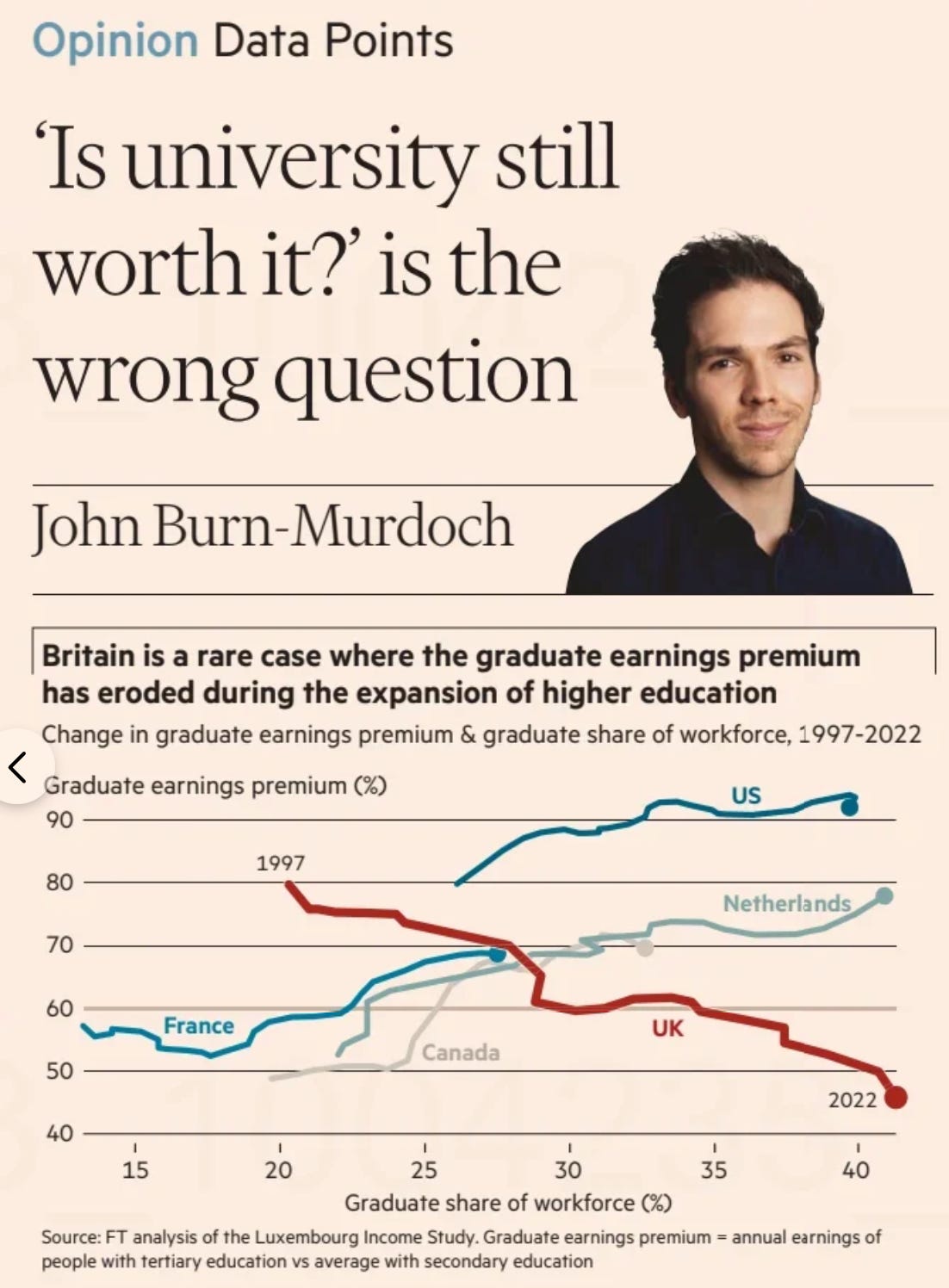
John Burn-Murdoch makes an interesting point in his recent column in the Financial Times: the wage premium of a university degree has stalled in the United Kingdom, unlike in other countries including the Netherlands and the United States, because the demand side (i.e. job structure) has not moved upwards as much. The share of managers and professionals has, for example, grown much faster in the other countries than in the UK. Many graduates in the UK therefore take up jobs below their educational level. Below a screenshot.
Does overeducation exist?
Possibly unknowingly, the column sheds light on a debate that goes on about the phenomenon of ‘overeducation’, on which in particular sociologists and economists seem to have different perspectives. According to neoclassical economists, the phenomenon of overeducation doesn’t really exist. People can be educated at levels higher than their job would require, but it would just mean that there are unobserved characteristics that explain that positioning. In other words, people are not overeducated for their jobs, but at most can they be overeducated relative to their ability (in my interpretation). That could still be called an inefficiency of educational allocation.
After economists have studied overeducation, sociologists embarked upon this topic, while economists have slowly abandoned it. For sociologists, it is still interesting to examine the matches and mismatches of education groups, because this thinking of labour markets explicitly links education to the occupational structure. Historically, occupations are the workhorses of social stratification for a sociologist, while economists think more directly of economic rewards. In the development of their interests, economists have come to embrace a ‘more is always better’ model of education: Because skills turn into economic growth, it is a wise policy to expand education, and we should not be worried too much about the occupational structure. Not only does the technologically advanced labour market of today reward skills more than before, but educated workers are also able to create technology. The skill-technology complementarity. An important consequence of this thinking, and convincing in my view, is that the labour market is not a static collection of jobs, but jobs are malleable, depending who takes the job. Overeducation or undereducation do not really exist; what will happen is that job tasks will be different between a university graduate and a high school graduate, even if they would, in theory, work in the same occupation.
Research on overeducation
Back in the early 2000s, economists would compare the wage returns to overeducated years of education and years of education needed for the job, and the above reasoning would assume that returns to years of education should be independent of whether the years are overeducated or not. With colleagues I have advanced on this idea by stipulating that the underlying human capital model of education may lead to better predictions in some institutional contexts than in others, while also other theories of why education is rewarded, such as education as a positional good, also works better depending on context. (See here and here).
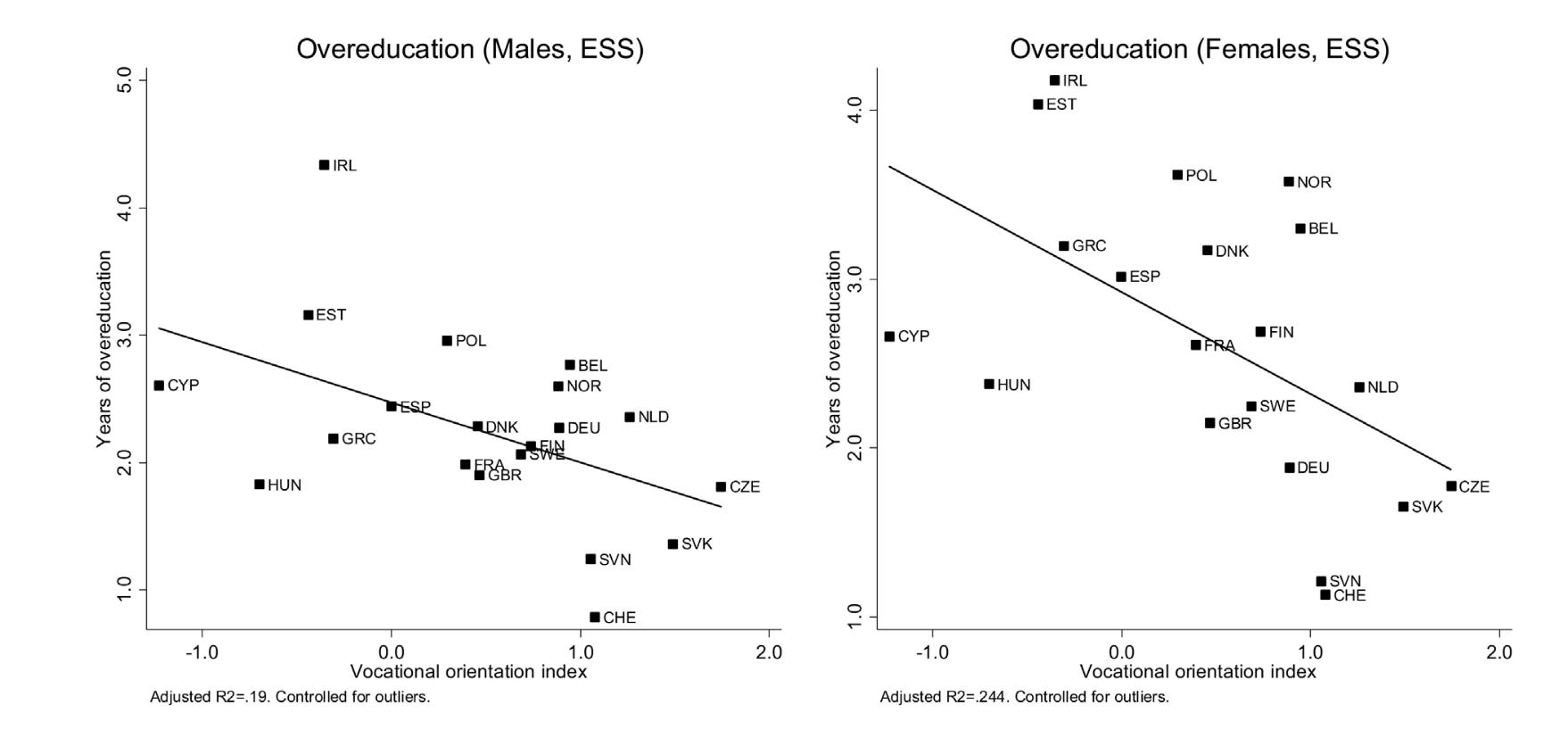
One important finding of our research was that overeducation is less prevalent in countries with a stronger vocational education and training system (in the European Social Survey of 2004, they had asked about the educational level required for the respondents’ current job, and comparing this to their educational level yields the measurement of overeducation). See the graph below from one of these papers.
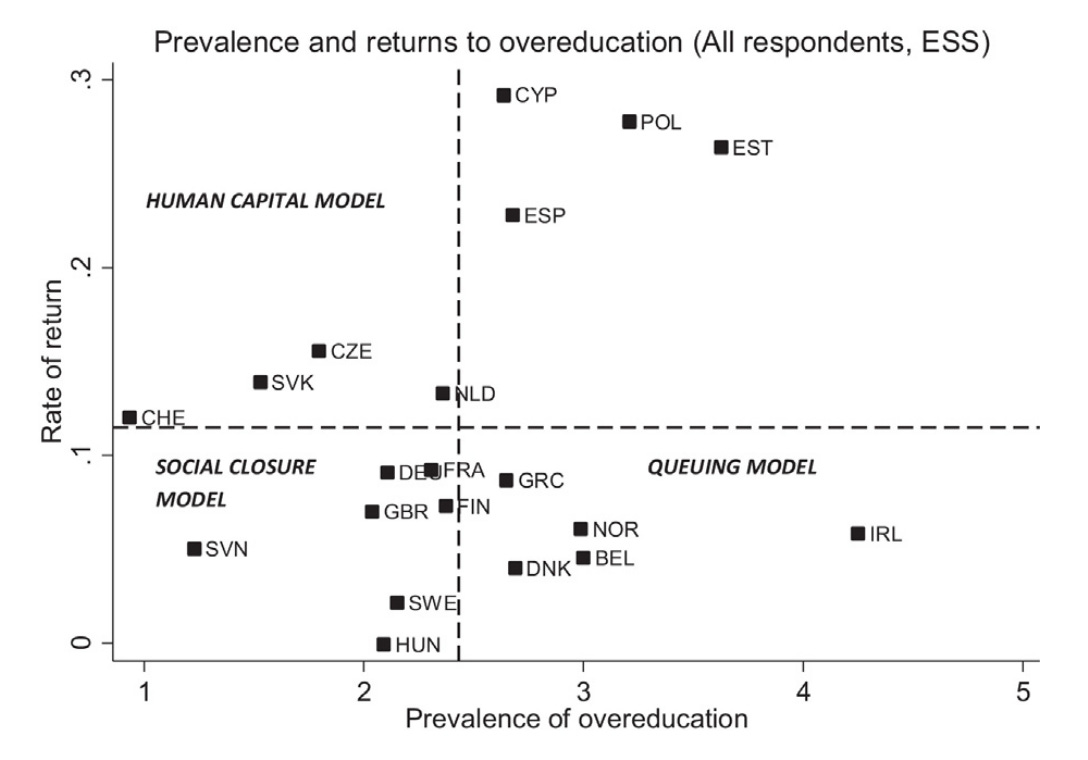
And the returns to overschooling, a sign of reward for human capital of workers independent of their occupation, also vary, see below for a summary of the findings. A human capital model is characterized by a low prevalence but a high return to overeducation. A social closure model shows a low prevalence and low return to education (as education is formally rewarded in the specific occupations where qualifications are demanded for other reasons than productivity), and a queueing model (education as a positional good) has high prevalence of overeducation and a low return (employers will take the applicant with the highest possible qualification, but the productivity is attached to jobs not to individuals). Interestingly, the UK (GBR) had low prevalence of overeducation back in 2004, and also a low return, which supposes that the occupational structure was in fact quite important for reward, independent of who fills a position.
So what does the piece in FT mean for all of this?
The piece in the FT, stating that the UK occupational structure has not moved along enough with the increased supply of skills, would assume that the job structure is more important than the contemporary thinking of economic theory holds. Indeed, overschooling may be a real phenomenon, and indeed the right question may not be whether we need all those university degrees, but how the occupational structure can be changed to cater to them.